Niamey hosts a steady flow of workshops, training sessions, donor meetings, regional consultations and press conferences. Organising one successfully means combining the usual event-planning basics with local realities: intense heat, power cuts, visa lead times, a multilingual audience and a demanding security environment. This guide sets out a step-by-step approach to planning a conference or seminar in Niamey, from the first brief to the closing reception.
Travel advisory (October 2026): the US State Department rates Niger Level 4 – Do Not Travel, and the UK Foreign, Commonwealth & Development Office advises against all travel to Niger, including Niamey. Several other governments give similar advice. Check your own government's latest guidance, and your travel insurance, before planning any trip.
Step 1: Define the brief
- Objective and format: plenary conference, interactive workshop, training course or press briefing.
- Participants: number, origin (local, regional, international) and languages.
- Dates and duration: avoid major religious holidays and, if possible, the hottest months of April and May.
- Budget: venue, catering, equipment, accommodation, transport, interpretation and security.
Step 2: Choose the right venue
Hotels are the most common venues in Niamey because they combine meeting rooms, accommodation, catering and controlled access. When comparing options, check:
| Criterion | Questions to ask |
|---|---|
| Capacity and layout | Maximum numbers in theatre, classroom, U-shape and cabaret layouts |
| Audio-visual | Projector, screen, microphones, sound system, interpretation booths |
| Connectivity | Wi-Fi capacity for all participants; wired backup for streaming |
| Power | Generator capacity and switch-over time during outages |
| Cooling | Reliable air conditioning for a full room in the hot season |
| Security | Access control, guards, screening, emergency procedures |
| Catering | Coffee breaks, lunches, dietary options, reception spaces |
| Accommodation | Rooms on site for international participants |
Example: Hotel Gaweye
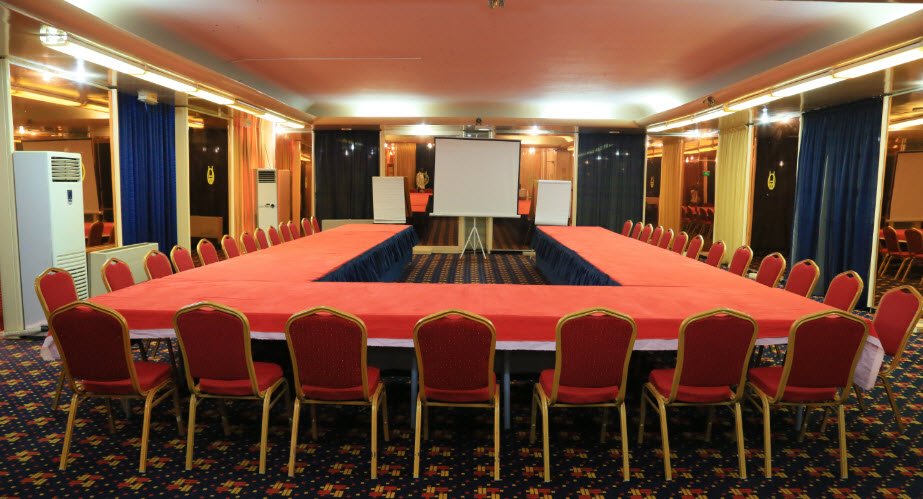
Hotel Gaweye offers two multipurpose conference rooms for 50 to 200 people, with a video projector, large screen, wireless internet and coffee-break service. Its restaurant La Potinière seats up to 150 guests, a catering and banquet service handles receptions, and participants can stay in the hotel's 200 rooms. The hotel has also described a backup generator, a fibre-optic connection and security measures including CCTV and an entrance detector. Confirm current equipment and capacities directly when you request a quote.
Step 3: Build a realistic timeline
| When | Task |
|---|---|
| 3–4 months before | Confirm dates and budget; shortlist and visit venues; risk assessment |
| 8–12 weeks before | Book venue and rooms; send invitations; issue invitation letters for visas |
| 4–6 weeks before | Book interpreters and equipment; finalise agenda and menus |
| 2 weeks before | Confirm participant list, transfers and security plan |
| Day before | Technical rehearsal: projection, sound, internet, generator test |
Step 4: Visas and travel for participants
International participants usually need a visa obtained in advance and a yellow fever certificate. Provide official invitation letters early and a hotel confirmation for each person. Our Niger entry requirements guide lists the documents. Arrange group airport transfers; Hotel Gaweye advertises an airport shuttle.
Step 5: Language and interpretation
Since 2025, Niger's transitional charter names Hausa as the national language, with French and English as working languages. In practice, French remains the main language of administration and business in Niamey, while Hausa and Zarma are widely spoken. For international events, plan French–English interpretation and translate key documents.
Step 6: Catering and comfort
- Schedule breaks every 90 minutes and provide plenty of water.
- Offer halal options; pork and alcohol should not be assumed acceptable.
- During Ramadan, adapt timings and offer an evening meal after sunset.
- Collect dietary requirements with registrations.
Step 7: Security and contingency
- Base the event on a written risk assessment and follow your organisation's security policy.
- Keep a participant list with emergency contacts; agree on a communication tree.
- Avoid publicising the venue and programme widely.
- Prepare alternatives: a remote-participation option, a backup date and a smaller fallback room.
- Review our Niamey travel safety guide.
Day-of checklist
- Room layout, signage and registration desk ready one hour early.
- Projector, microphones and laptop connections tested.
- Internet password distributed; backup connection available.
- Generator and air conditioning checked.
- Coffee break and lunch times confirmed with the kitchen.
- Security briefing for staff and organisers.
Budgeting your event
Costs in Niamey are usually quoted in CFA francs. When requesting quotes, ask for a detailed breakdown so that you can compare venues fairly:
- Room hire per day or half day, including set-up and equipment.
- Coffee breaks and lunches per person, with menus.
- Accommodation rates for participants, with breakfast and taxes.
- Interpretation, sound equipment and booths if needed.
- Transport: airport transfers and daily shuttles.
- Security costs where required by your organisation.
Keep a contingency of around ten percent for last-minute changes, extra participants or additional equipment, and confirm payment terms and deposit conditions in writing.
After the event
Close the loop: thank participants, share presentations and conclusions, collect feedback and settle invoices promptly. Note what worked with the venue, the caterer and the transport providers, so that your next event in Niamey starts from a solid base.
Hybrid and remote participation
Many events in Niamey now combine in-person and online participants, which is also a useful fallback if travel becomes impossible at short notice. Plan a dedicated wired connection for streaming, a camera that shows the speaker and the room, a good microphone and a moderator who follows the online chat. Test the full set-up the day before, with a remote colleague, and prepare a recording in case the connection drops.
Frequently asked questions
How far in advance should I book a venue in Niamey?
For events with international participants, start at least three months ahead to allow time for visas and logistics.
Which language should the event use?
French is the usual working language for business in Niamey; provide English interpretation for international audiences.
What happens during a power cut?
Choose a venue with a generator, ask how quickly it takes over, and keep laptops charged.
Can participants stay at the conference venue?
In hotel venues such as Hotel Gaweye, yes: participants can stay in the hotel's rooms, which simplifies transport and security.
Conclusion
A successful event in Niamey depends on preparation: the right venue, reliable power and cooling, early visa support, good interpretation and a clear security plan. Start early, test everything the day before, and keep a plan B. For accommodation options, read our hotel checklist.
Planning a stay in Niamey? Discover Hotel Gaweye's rooms, restaurants and meeting rooms by the Niger River.
Hôtel GaweyeRooms & suites